
There’s not much known about
Hector Guimard’s life, most of it remains a mystery beside that he was born in Lyon in 1867 and got his
education at l’Ecole Nationale des Arts Decoratifs and L’Ecole Nationale des Beaux-Arts.
As soon as they’ve got their chances to study abroad aspiring architects eagerly rushed to Italy to study antique ruins and classic marvels of Renaissance and Baroque without which the architectural education wouldn’t be considered complete.
When young Guimard won his bursary award he rushed as quickly in the opposite direction to Belgium, England and Scotland to study modern architecture and trends to see for himself the design experiments by young and talented architect Charles Rennie Mackintosh. Guimard had no intention to follow tradition, even at school he had a nickname of rebel. And while the tradition called to derive the inspiration from the past Guimard felt another calling: modernity ideas, innovative materials and forms, metal and glass and for that matter the accessibility of elegant style and design. Influenced by the ideas of Viollet-le-Duc of finding the ideal forms for specific materials he was stepping on his path of architectural innovations.

This is the entrance hall of Castel Beranger shot through the gate. It's a bit blurry as I had to zoom in on max and there wasn't enough light but elaborate ironwork, floor tiles and stained glass are so beautiful. An art Nouveau masterpiece.
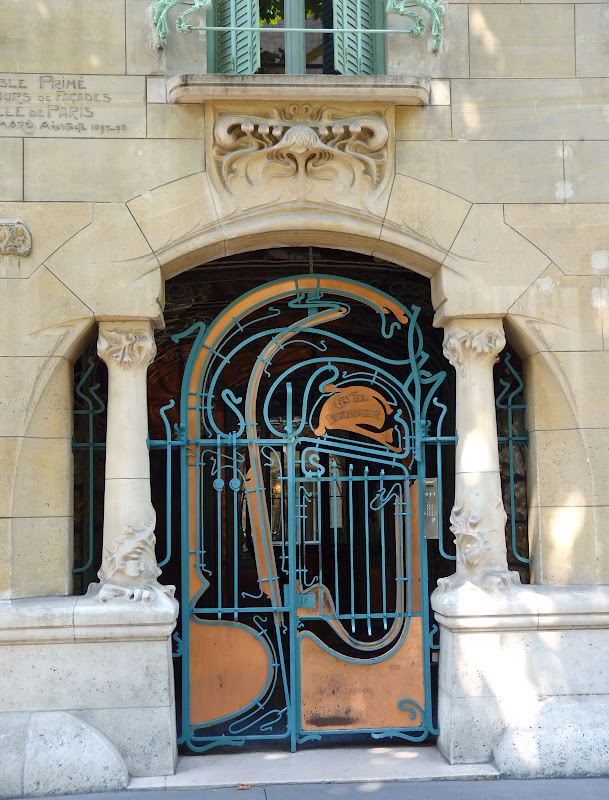
The Castel Beranger gate is an iconic masterpiece included in every Art Nouveau book.


Look at these calligraphic lines. There's no such thing as a small or unimportant detail for Art Nouveau artist. Every stroke is meaningful even a grill on a side window.
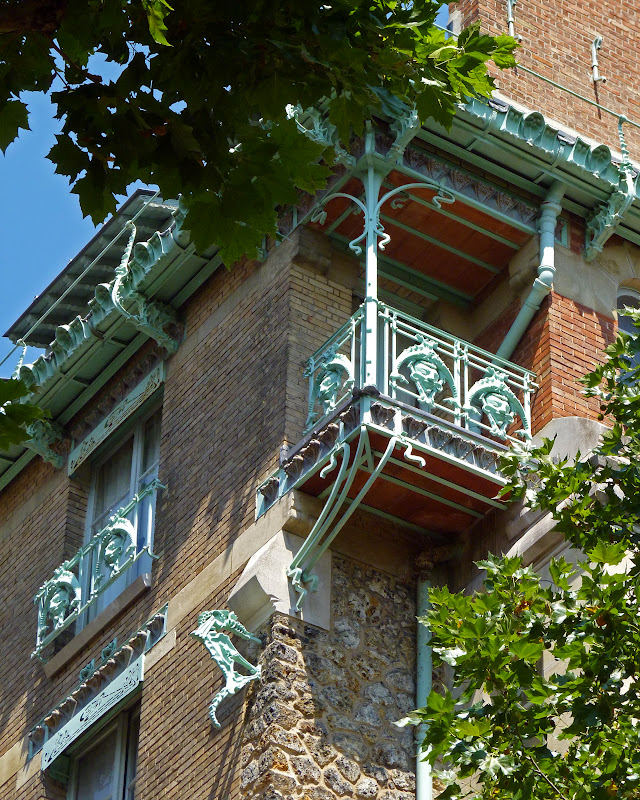
A few dragons on a side and sleeping lions are pretty friendly non ferocious beasts.

To get a clean shot one should try in winter when trees aren't obstructing a view.
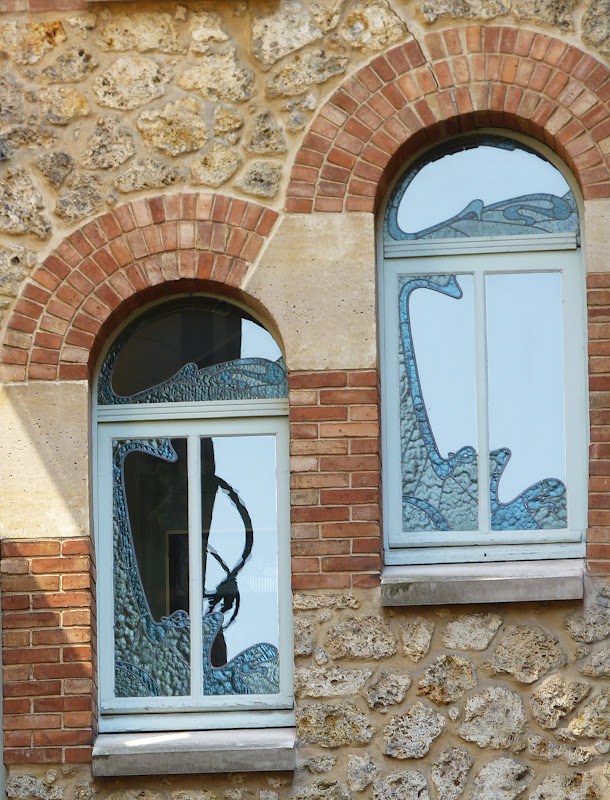

The side view of Castel Beranger apartment complex. I'm wondering how does it look inside?
Notice the stained glass in windows.
Notice the stained glass in windows.

Pastel green, brick and stone texture, curvaceous lines.

The inner doorway to the enclosed courtyard. Looking through the gate.

This building won for Guimard a much deserved recognition which is proudly noted on the facade and signed by the architect.
Meeting Victor Horta, the
most prominent Art Nouveau architect in Brussels, seeing his works, had the
most powerful impact on Hector Guimard’s
own style and life time devotion to Art Nouveau diversity and flexibility.
By that time his masterpiece
Castel Beranger, a three building apartment complex in Paris 16th
Arrondissement was already under construction and Guimard reworked it to test
his own ideas of complex outside/inside design, exterior/interior artistic
connection. He designed wall panels, wall paper, mantels, furniture, lighting,
window glass staining as well as ceramics and miscellaneous decorative
artifacts up to the door handles to create the whole new experience for a modern dwelling.
As an architect, engineer, designer and decorator striving for stylistic harmony he could successfully play any instrument, be a conductor and soloist in this creative orchestra.
As an architect, engineer, designer and decorator striving for stylistic harmony he could successfully play any instrument, be a conductor and soloist in this creative orchestra.
This work of 1895-1898 was
highly praised and right after that Guimard got his Metro entrances commission in
1899 which made him immortal.

Hotel Guimard, 1909. In this house Hector Guimard and his wife Adeline lived for almost 30 years. It could be Museum Guimard, but helas...
In 1909, at the age of 41,
Gimard married Adeline Oppenheim, a New Yorker from a wealthy Jewish family,
who studied painting in Paris. And they lived happily ever after in the Hotel
Guimard, a wedding present built by Guimard on Mozart Avenue, the most unconventional
house in the 16th Arrondissement.

There were a few more prosperous years before WWI when Art Nouveau rapidly faded giving way to Art Deco and various Constructivism ideas.


The discrete initials HG above the ornamented door. Elegant wrought iron balconies.
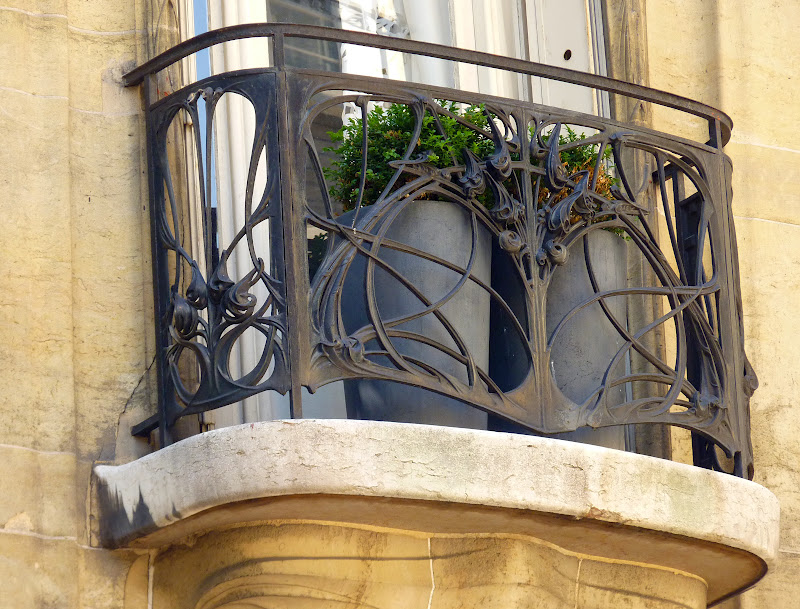
Guimard tried to adapt taking on industrial projects. But by 1930s he was out of vogue and his talents not in demand.
In 1938 at the onset of anti-Semitism
and WWII a couple fled to New York and settled at the Upper East side. In 1942
one of the most distinguished French architects Hector Guimard largely ignored and
forgotten in his homeland died in New York.

Hotel Mezzara , 1911. Not open for the public but judging from books it has a fantastic hall on the ground floor with skylight ceiling and galleries.


Balcony and door. Hotel Mezzara, 1911.
Notice the details and surface textures.
After the war in 1949 his
widow made all gracious efforts to donate Hotel Guimard to France to open a
Guimard Museum in Paris as it was proudly done in Belgium where Victor Horta’s
home became a museum in Brussels.
Regretfully her generosity
wasn’t met positively and didn't find a support. Simply speaking the gift was refused and
the house was sold and the interior was divided into apartments.
It’s an apartment building
now available for rent.
Otherwise the priceless
collection and archives moved overseas.
The ensemble of each room
and a house as a whole, the unification of all the elements of the building was
very important for the architect’s vision and Madame Guimard devoted another 23
years of her life to commemorate the legacy of her great husband donating his
work to various US museums and collections.

I hope you enjoyed this brief overview of Hector Guimard's legacy.
To be continued.
And have a wonderful weekend my dear friends.


